GENDER EQUITY INDEX
The Gender Equity Index (GEI) measures progress toward equity for women and girls in Miami-Dade County. Its goal is to drive collaboration in the advancement of gender equality.
Persistent Inequalities Must Drive Change for Women’s Empowerment.
Gender Equity Index
2024 Score, 53 points
Miami-Dade is 47 points away from achieving gender equality.
Gender Equity Index Score
The Gender Equity Index score has increased by 10 points over the past 14 years, reflecting moderate progress toward gender equity across its pillars—Economic Mobility, Health & Well-being, Leadership, and Freedom from Violence. At two points above the 2021 score, the 2024 score highlights minimal progress over the past few years.
The Gender Equity Index measures community progress toward gender equity in Miami-Dade County.
Data drives action, decision-making, and policy changes.
- The GEI, based on an international model and applied for the first time locally, reflects that women and girls face interconnected challenges, as obstacles in each of the Women’s Fund Miami-Dade (WFMD) four pillars – Economic Mobility, Health and Well-Being, Leadership, and Freedom From Violence – affect outcomes in the other three.
- The GEI provides actionable data to inform and assist policymakers and the broader community in improving gender equality. WFMD’s policy recommendations at the end of each policy paper support data-driven collaborative and sustainable solutions to documented gender disparities.
Economic Mobility
- Full time employment
- Median full time earnings
- Bachelor’s degree or higher
- High pay positions
- Poverty
Health & Well-being
- Health insurance
- Maternal morbidity
- Infant mortalilty
- Disability
- Teenage pregnancy
Leadership
- Voter turnout
- Representation in elected positions
- Voter registration
Freedom From Violence
- Domestic violence
- Sex offenses
- Overall crime
- Human trafficking
4
Pillars
17
Metrics
15
Years of Data
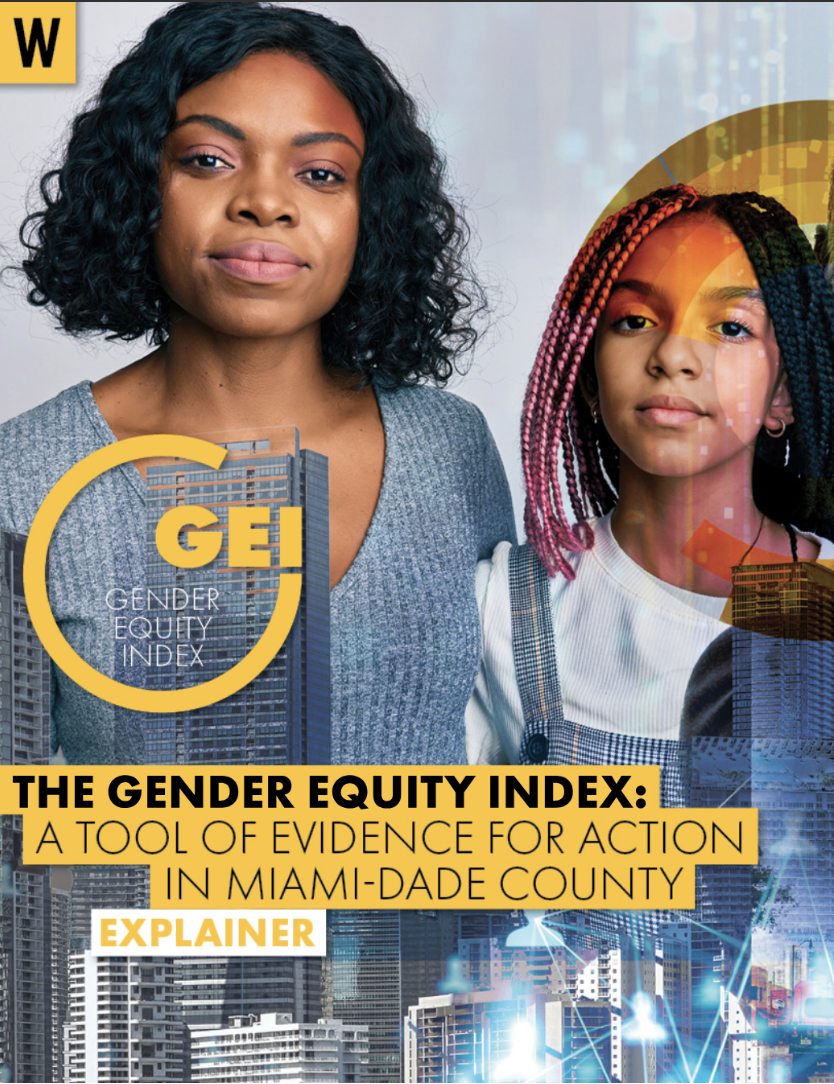
The Miami-Dade
Gender Equity Index:
A Tool of Evidence for Action in Miami-Dade County
The GEI explainer describes the Index, the rationale and methodology of its development, and why it’s necessary to achieve gender equity in Miami-Dade County. Each GEI score will be accompanied by a policy paper examining one of the four pillars of The Women’s Fund.
Quick Insights
Our one-pagers provide a snapshot of the key points, findings, and recommendations from our in-depth policy paper for each WFMD pillar. Whether you’re a policymaker, advocate, or simply seeking a quick overview, these concise documents offer a straightforward way to grasp the core content.
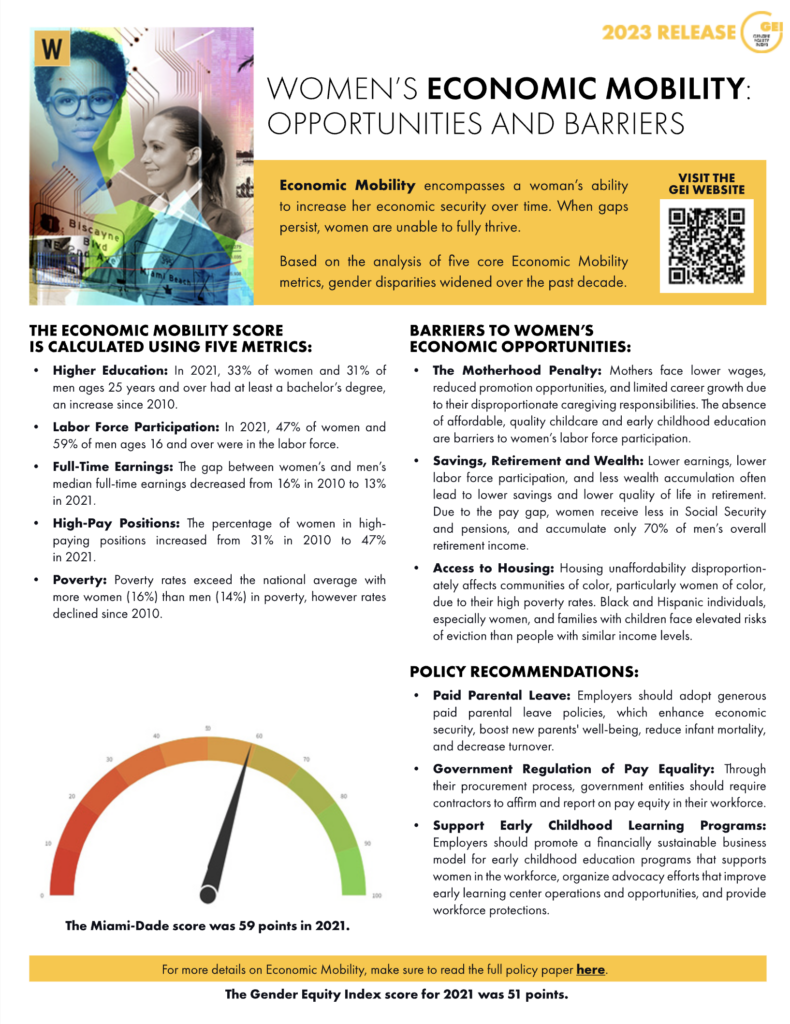
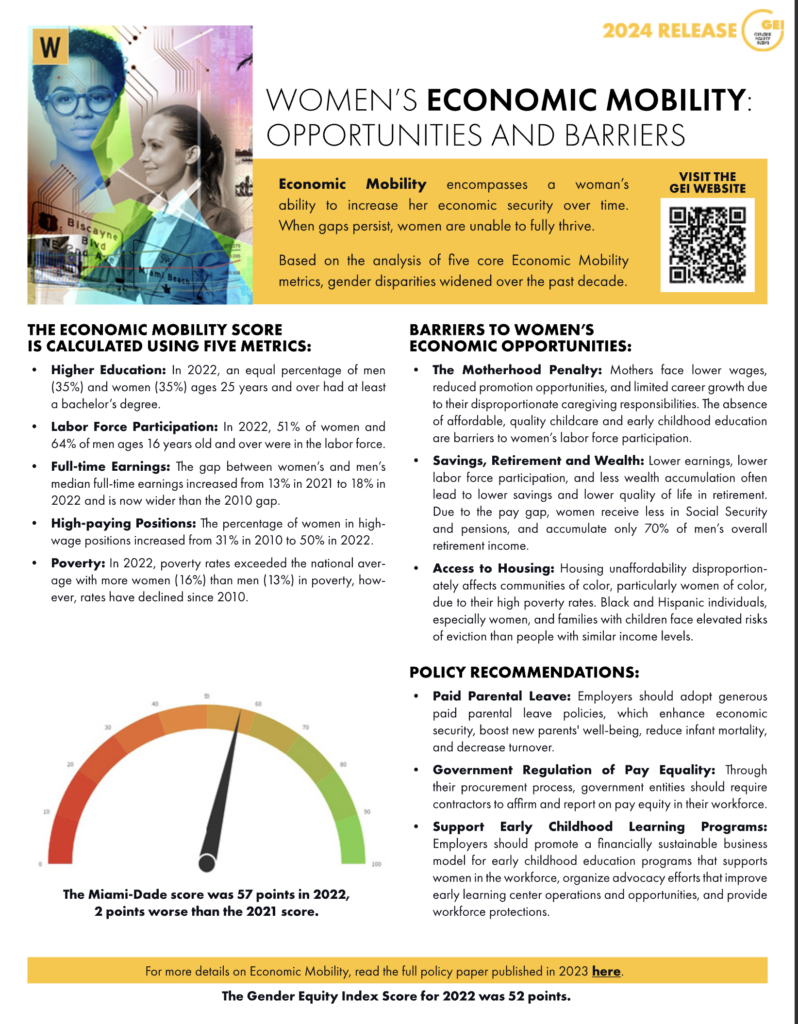
Economic Mobility
Women’s Economic Mobility Opportunities and Barriers
Click thumbnail to read the one-pager:
Click thumbnail to read the one-pager:
Click thumbnail to read the one-pager:

Click thumbnail to read the one-pager:

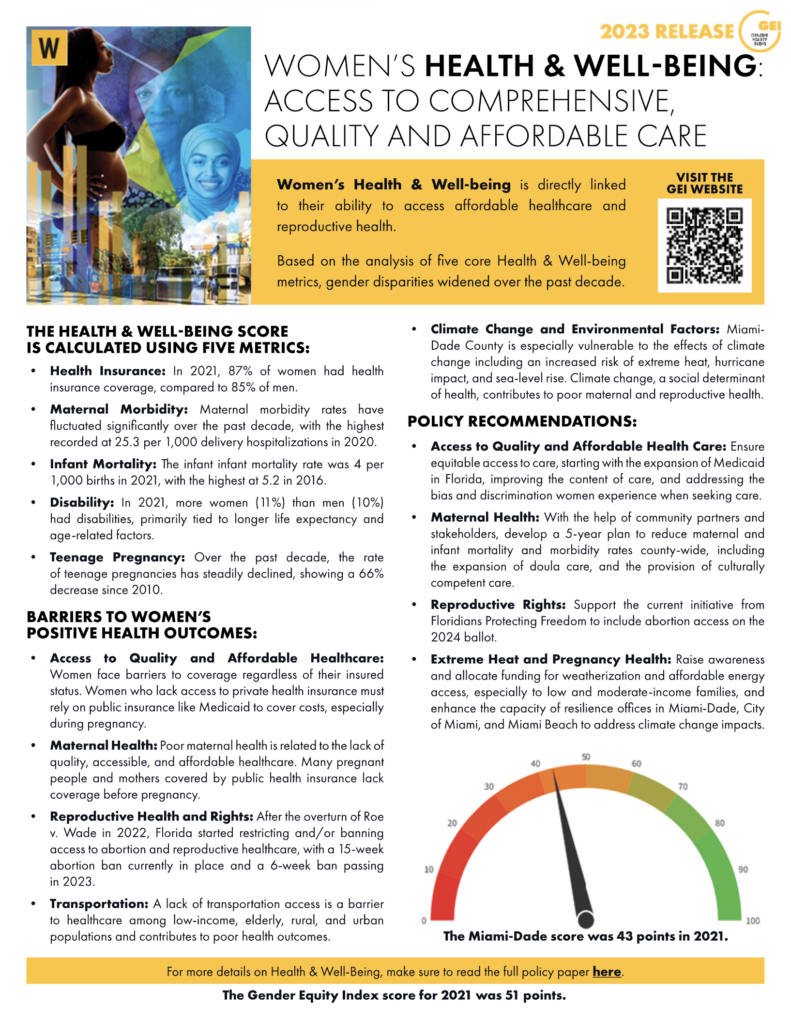
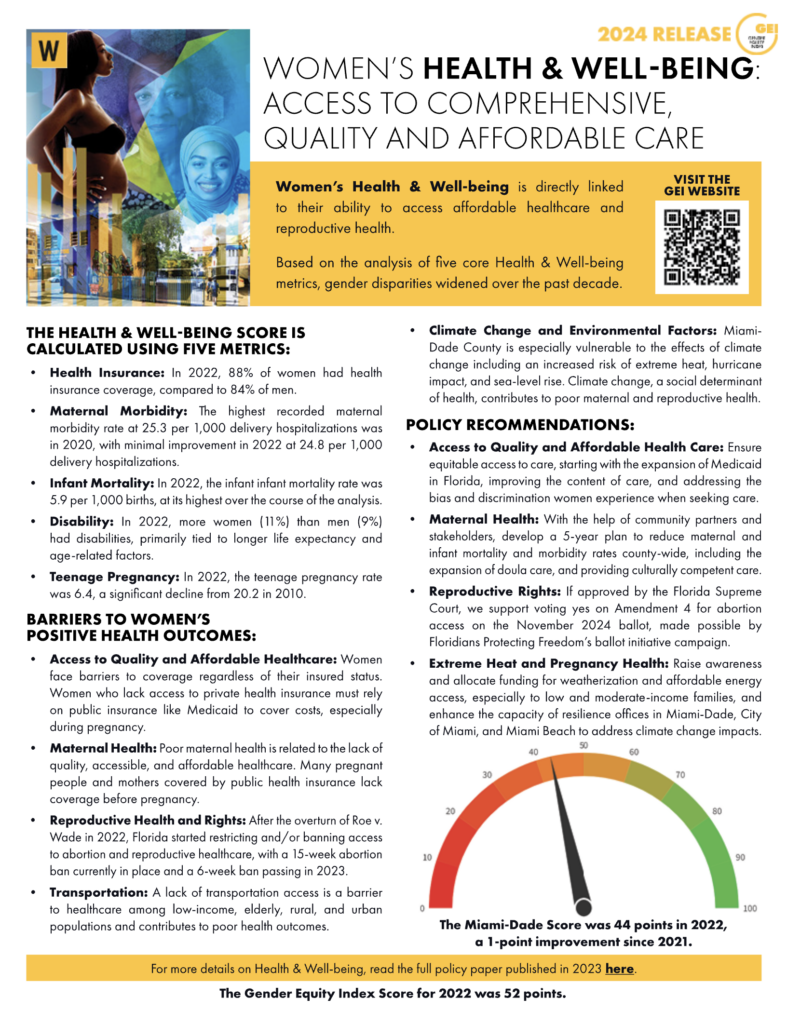
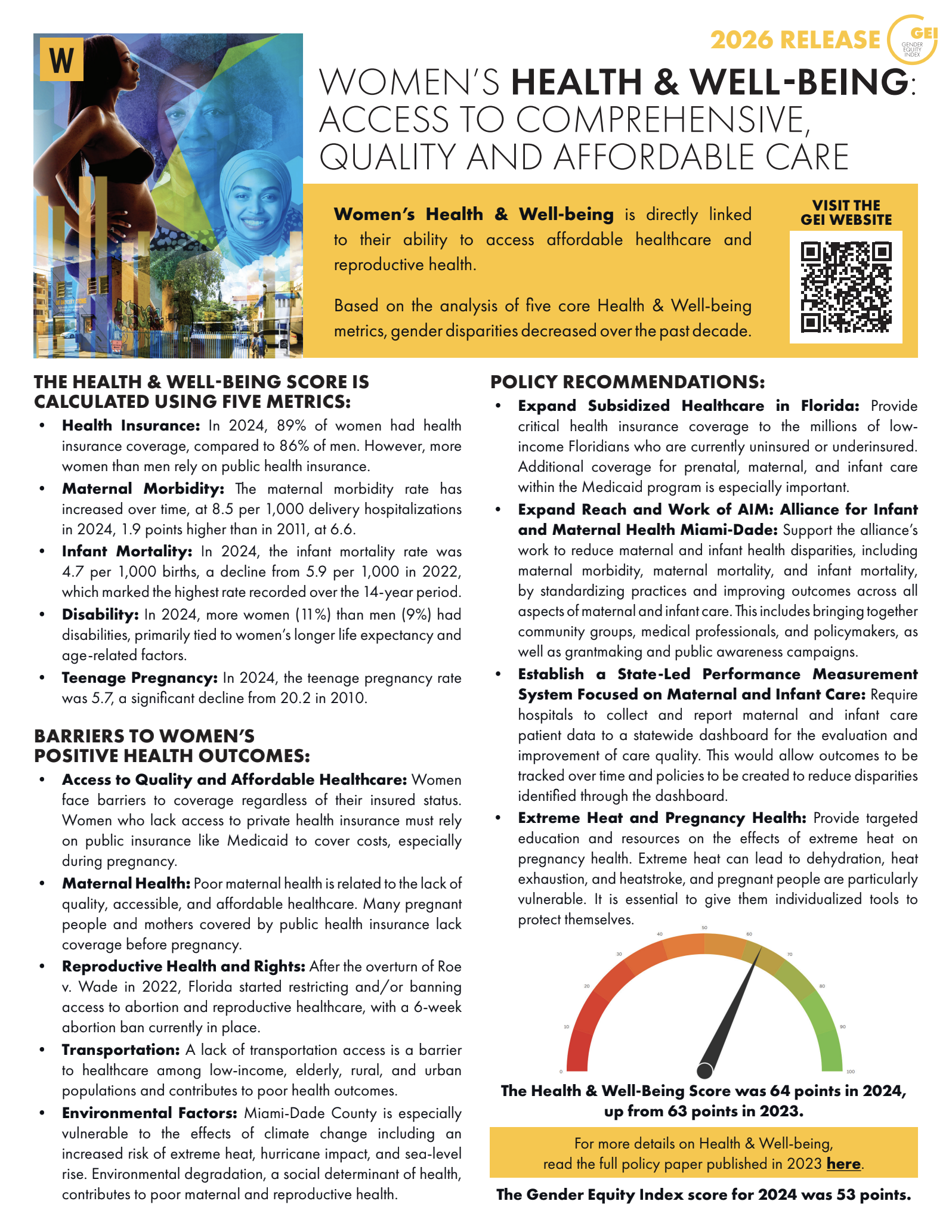
Women’s Health & Well-Being
Access to Comprehensive, Quality and Affordable Care
Click thumbnail to read the one-pager:
Click thumbnail to read the one-pager:
Click thumbnail to read the one-pager:

Click thumbnail to read the one-pager:
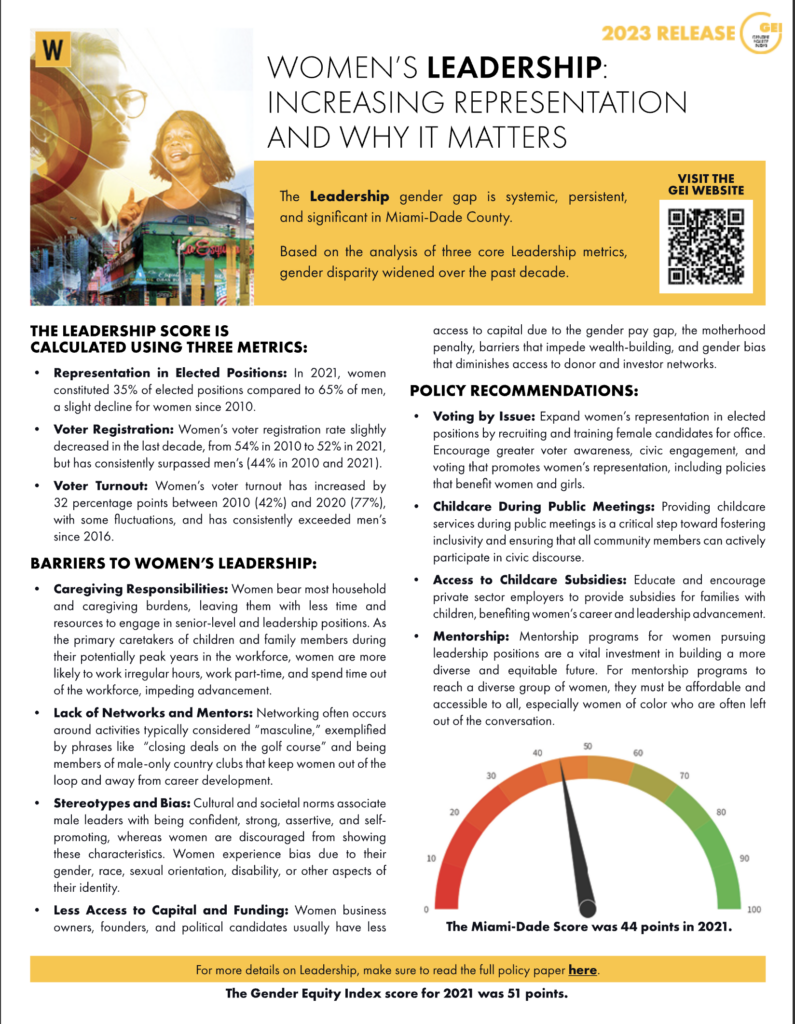
Women’s Leadership
Increasing Representation and Why It Matters
Click thumbnail to read the one-pager:
Click thumbnail to read the one-pager:
Click thumbnail to read the one-pager:

Click thumbnail to read the one-pager:

Freedom From Violence
Achieving Women’s Security & Empowerment
Click thumbnail to read the one-pager:
Click thumbnail to read the one-pager:
Click thumbnail to read the one-pager:

Click thumbnail to read the one-pager:
Economic Mobility Score
Based on the analysis of the five core Economic Mobility metrics – higher education, labor force participation, full-time earnings, high-pay positions, and poverty – gender disparity narrowed for economic mobility.
The Economic Mobility score was 64 points for 2024, indicating a 14-point rise from the 2010 score (50 points) and a 1-point increase from the 2023 score.
Full Time Employment
In Miami-Dade, 52% of women and 64% of men participated in the labor force in 2024. The disparity in labor force participation can be attributed to several barriers, including women’s traditional gender roles, a lack of access to quality and affordable childcare, and the benefits cliff.
Median Full Time Earnings
In Miami-Dade, women’s median full-time earnings for 2024 were 12% below those of men. The gender pay gap decreased by 6 percentage points from 2022 (18%), when it was at its highest point since 2019 (19%).
Women in Miami-Dade earn 88 cents for every dollar earned by men.

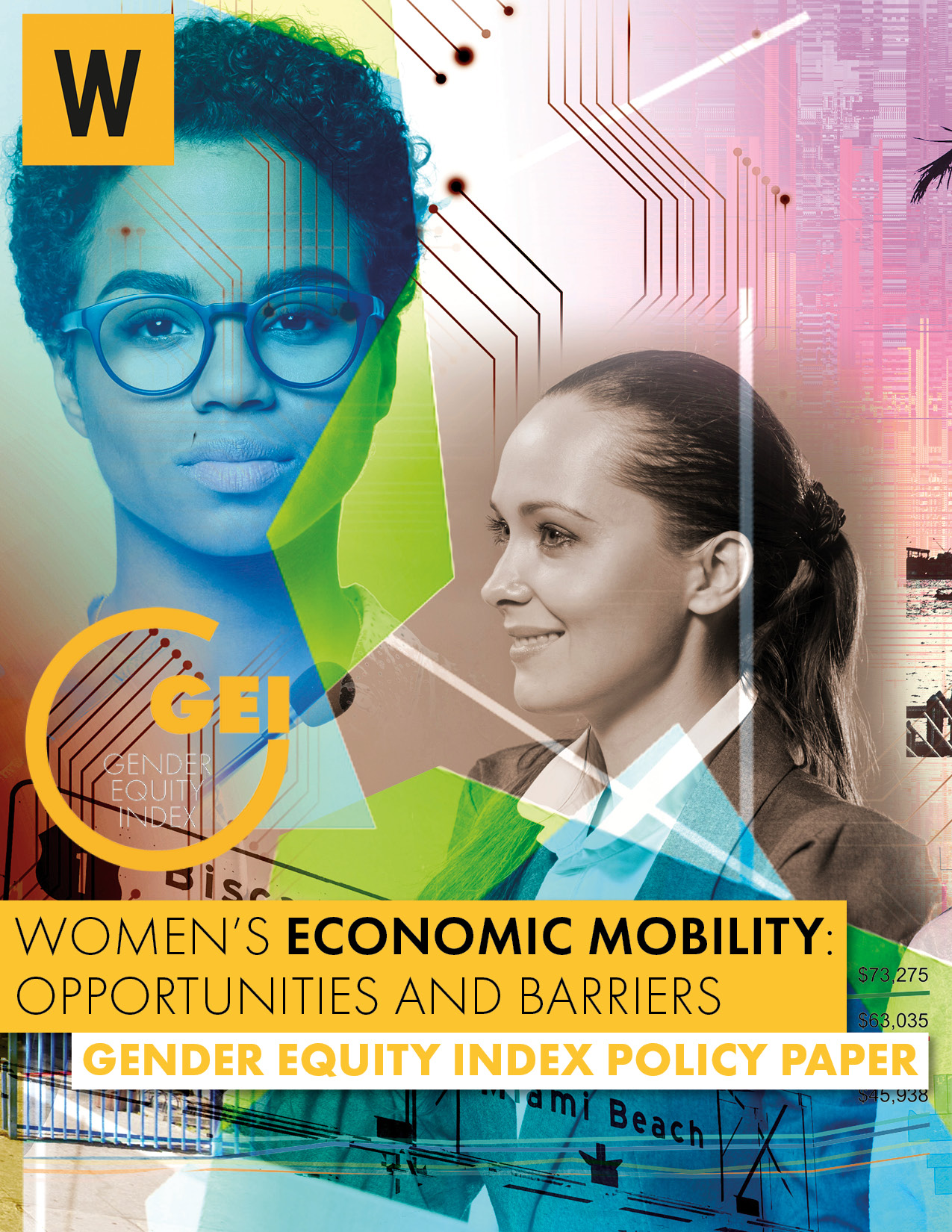
Women’s Economic Mobility: Opportunities and Barriers
Gender Equity Index Policy Paper
This policy paper focuses on the Economic Mobility score, offering an in-depth understanding and analysis of the individual metrics and the methodology used to determine the score, as well as the barriers to women’s economic freedom.
Health & Well-Being Score
Based on the analysis of the five core Health & Well-being metrics – health insurance, maternal morbidity, infant mortality, disability, and teenage pregnancy – gender disparity narrowed over the last decade.
The Health & Well-Being score was 64 points in 2024, indicating a 4-point improvement from the 2010 score (60 points) and a 1-point increase from 2023 (63 points).
Health Insurance
In Miami-Dade County, over the last decade, more women than men have had health insurance coverage, 89% of women compared to 86% of men in 2024. However, behind the numbers, gaps, and nuances exist in terms of the type of health insurance coverage women can access and afford, affecting their health outcomes.
Maternal Morbidity
In Miami-Dade County, the maternal morbidity rate has fluctuated over the past 14 years, currently at 8.5 per 1,000 delivery hospitalizations in 2024, 1.9 points higher than in 2011, at 6.6.
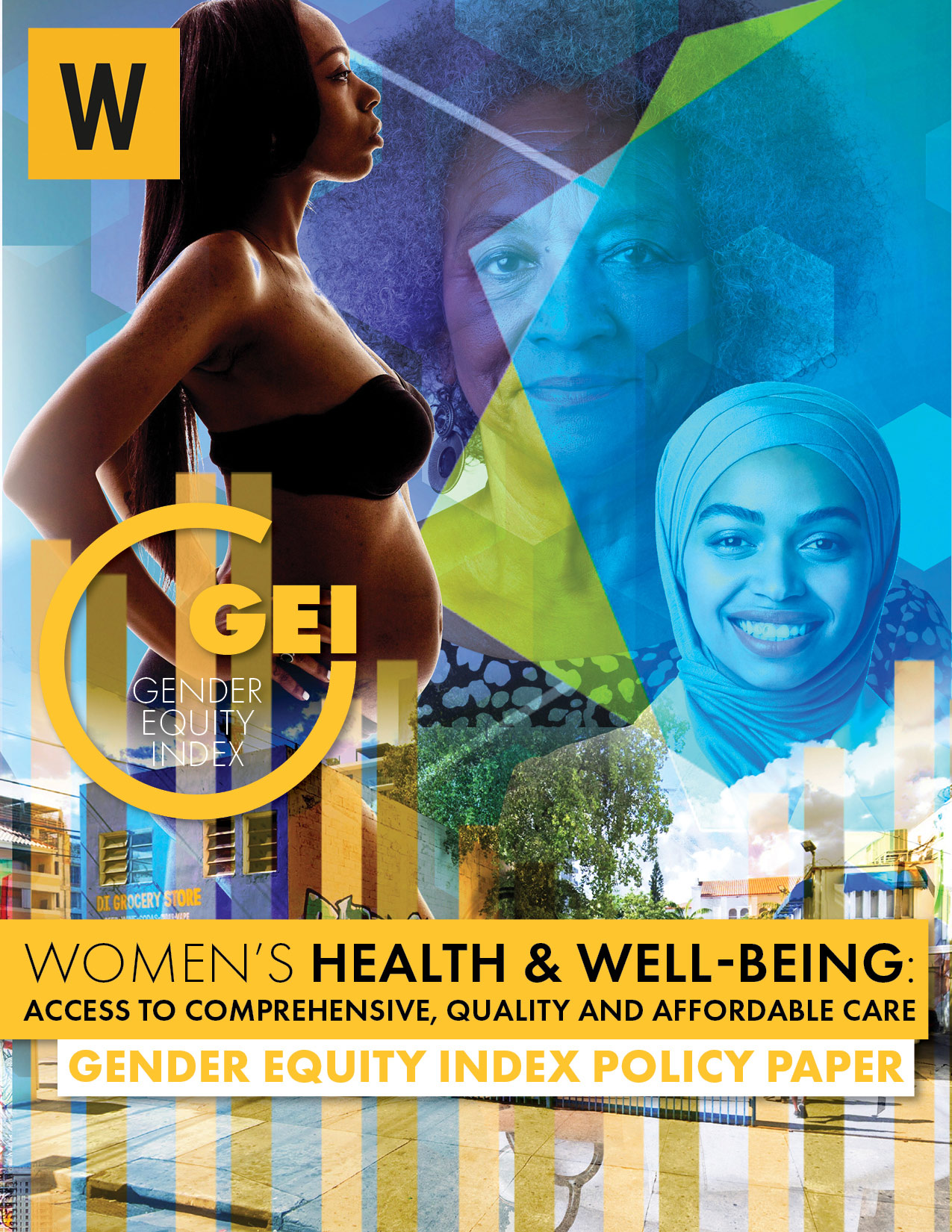
Women’s Health & Well-Being:
Access to Comprehensive, Quality and Affordable Care
This policy paper focuses on the Health & Well-Being score, offering an in-depth understanding and analysis of the individual metrics and the methodology used to determine the score, as well as the barriers to women’s positive health outcomes.
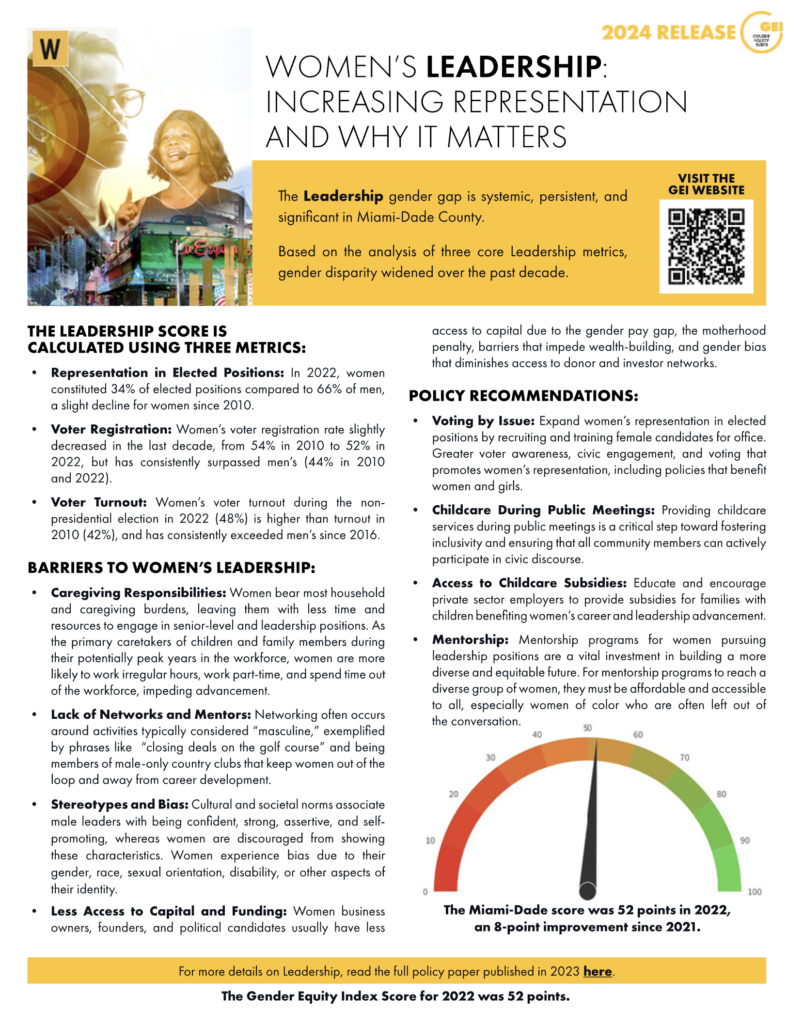
Leadership Score
Based on the analysis of the three core Leadership metrics – representation in elected positions, voter registration, and voter turnout – gender disparity decreased over the last decade.
The Leadership score was 63 points in 2024—a substantial improvement from the 2010 score of 53. However, the score has decreased by one point since 2021.
Representation in Elected Positions
In Miami-Dade County, women remain underrepresented in elected positions, falling behind the national trend. Women constituted 35% of elected positions compared to 65% of men in 2024.
Voter Turnout
Women’s voter turnout has consistently exceeded men’s since 2016. Women’s voter turnout has increased from 42% in 2010 to 48% in 2022 during non-presidential elections, and it was at its highest for the 2020 presidential election (76.5%), followed by the 2016 presidential election (75.2%). Turnout for women dipped slightly in 2024, at only 73.9%.
Women’s
Leadership
Increasing Representation and Why It Matters
This policy paper focuses on the Leadership score, offering an in-depth understanding and analysis of the individual metrics and the methodology used to determine the score, as well as the barriers to women’s leadership.
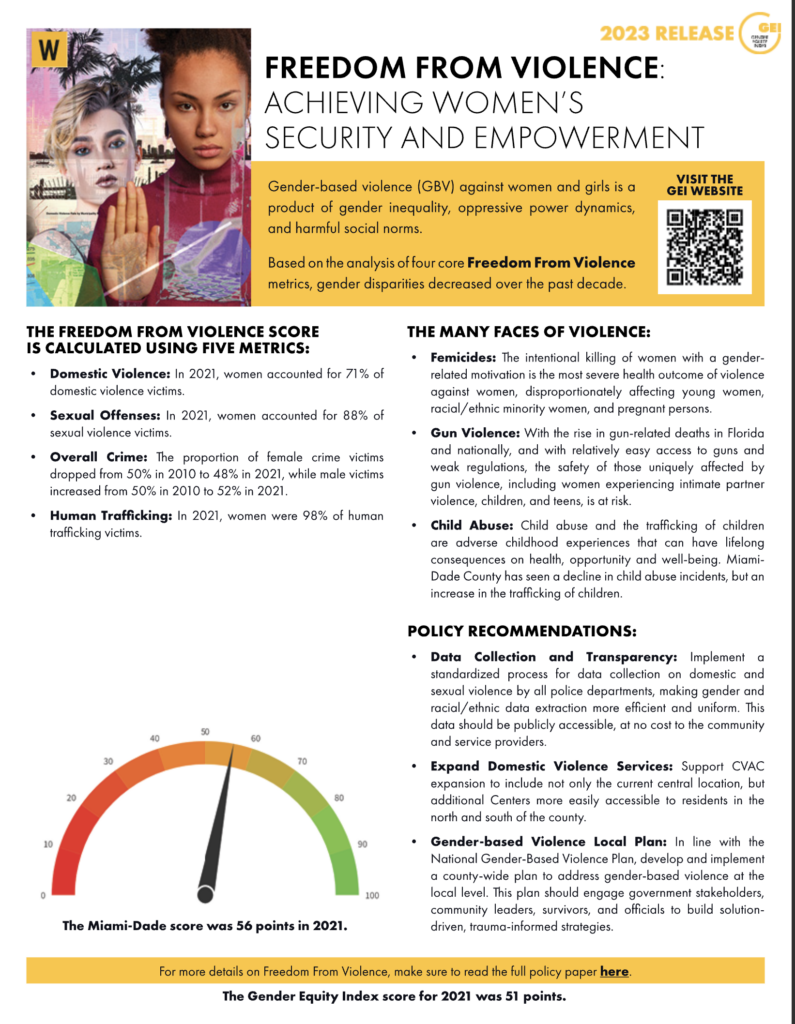
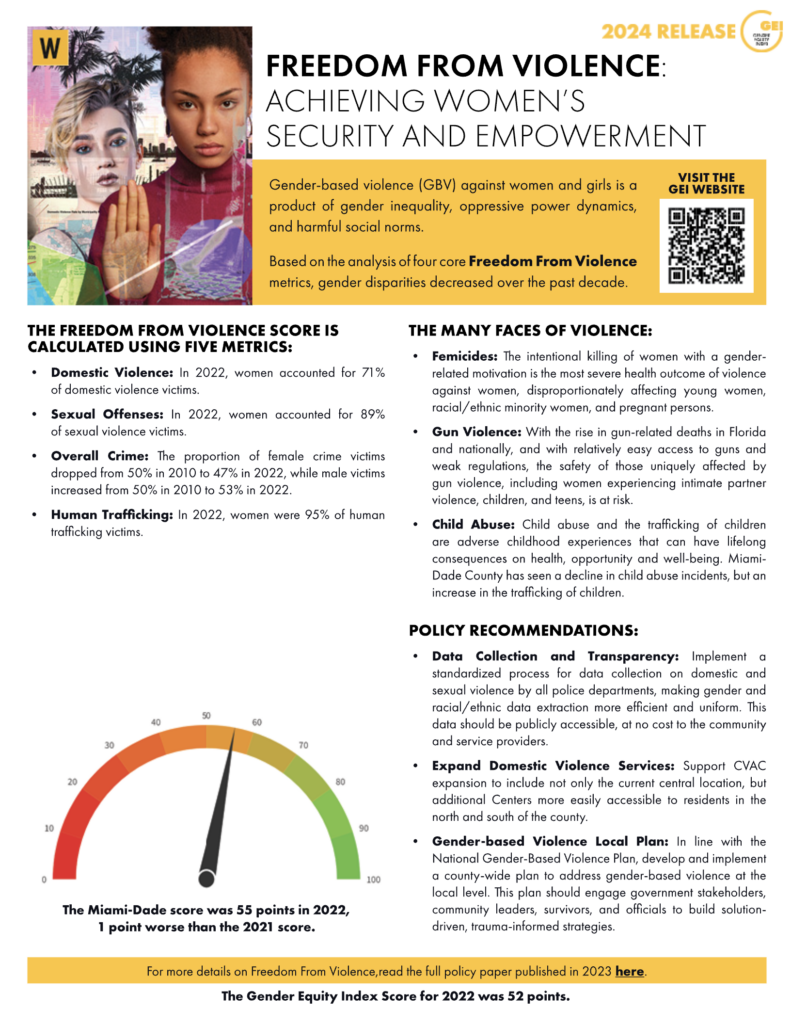
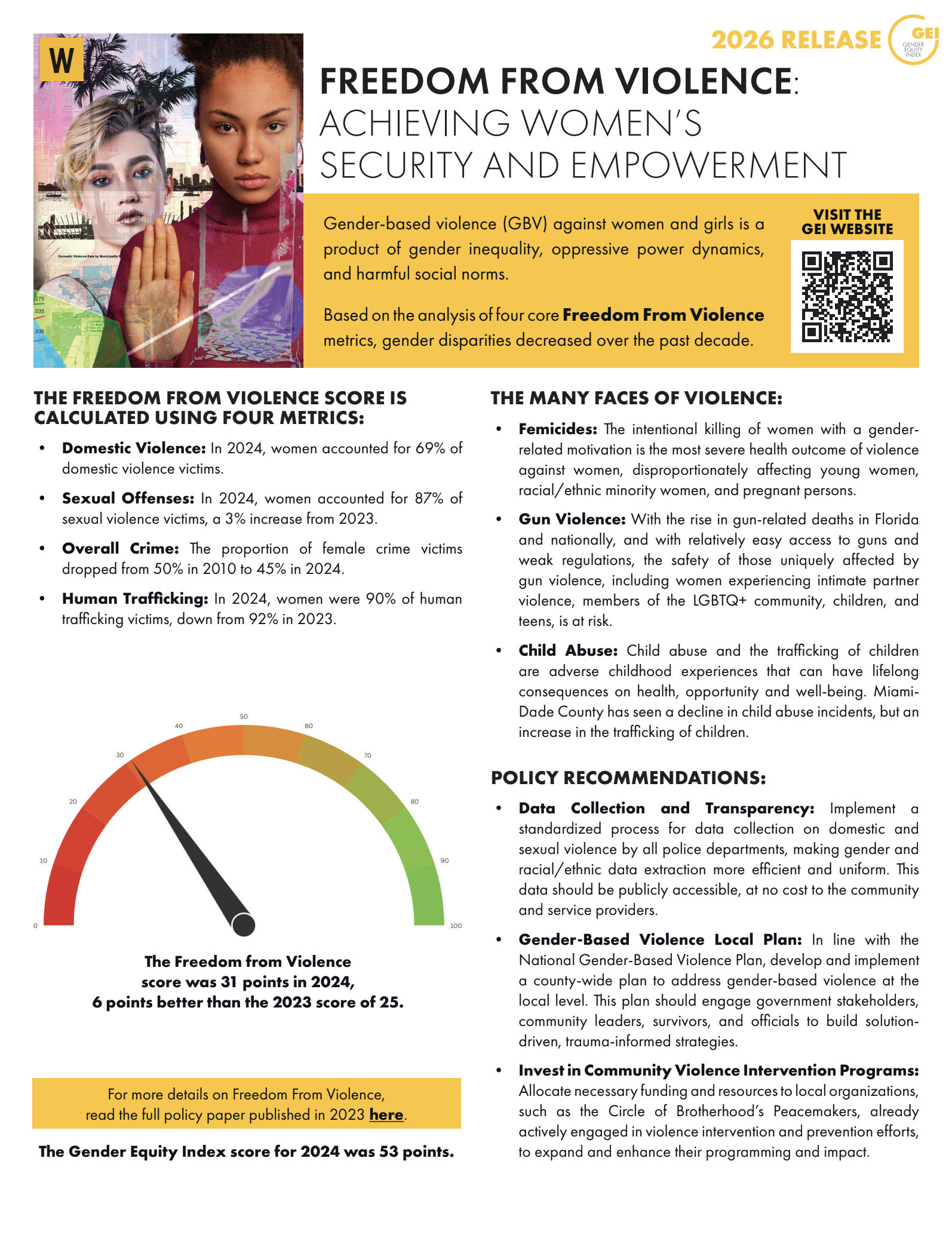
Freedom From Violence Score
Based on the analysis of the four core Freedom From Violence metrics – domestic violence, sexual violence, human trafficking, and overall crime – gender disparity decreased over the last decade.
The Freedom From Violence score was 31 points in 2024, a 6-point increase from the 2023 score (25 points).
Domestic Violence
The rate of domestic violence experienced by women has historically been more than double that of men.
In 2024, women accounted for 69% of domestic violence victims in Miami-Dade County. Over the last decade, there has been a slow but continuous decline in the proportion of women victims, with an increase in male victims.
Sexual Violence
Women experience sexual violence at a significantly greater rate than men. Women accounted for 87% of sexual violence victims in 2024, a 3% increase from 2023.
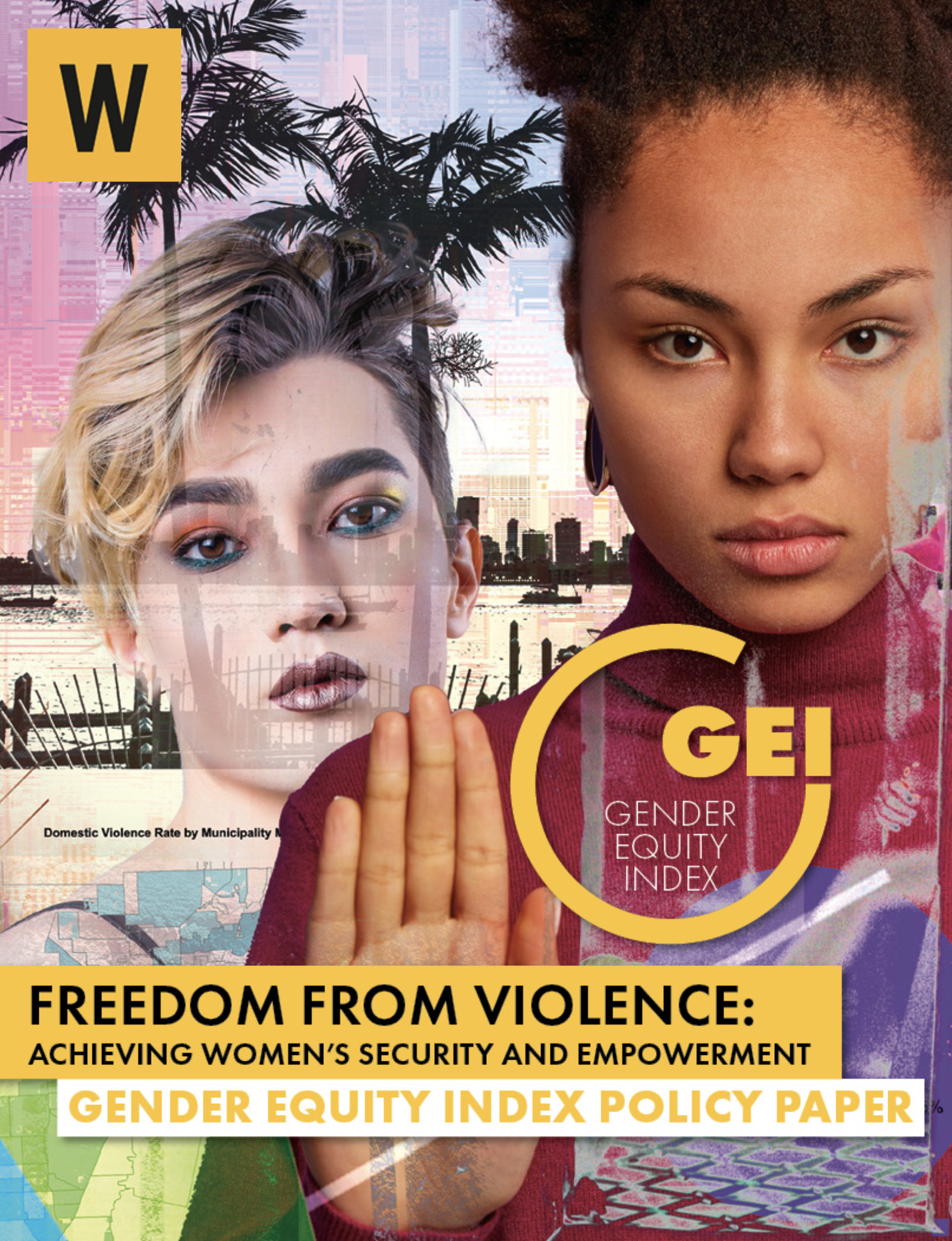
Freedom From Violence:
Achieving Women’s Security and Empowerment
This policy paper focuses on the Freedom From Violence score, offering an in-depth explanation of the individual metrics, the methodology used to determine the score, and an analysis on the different types of violence against women.
Subscribe
The Gender Equity Index is created with support from The Children’s Trust