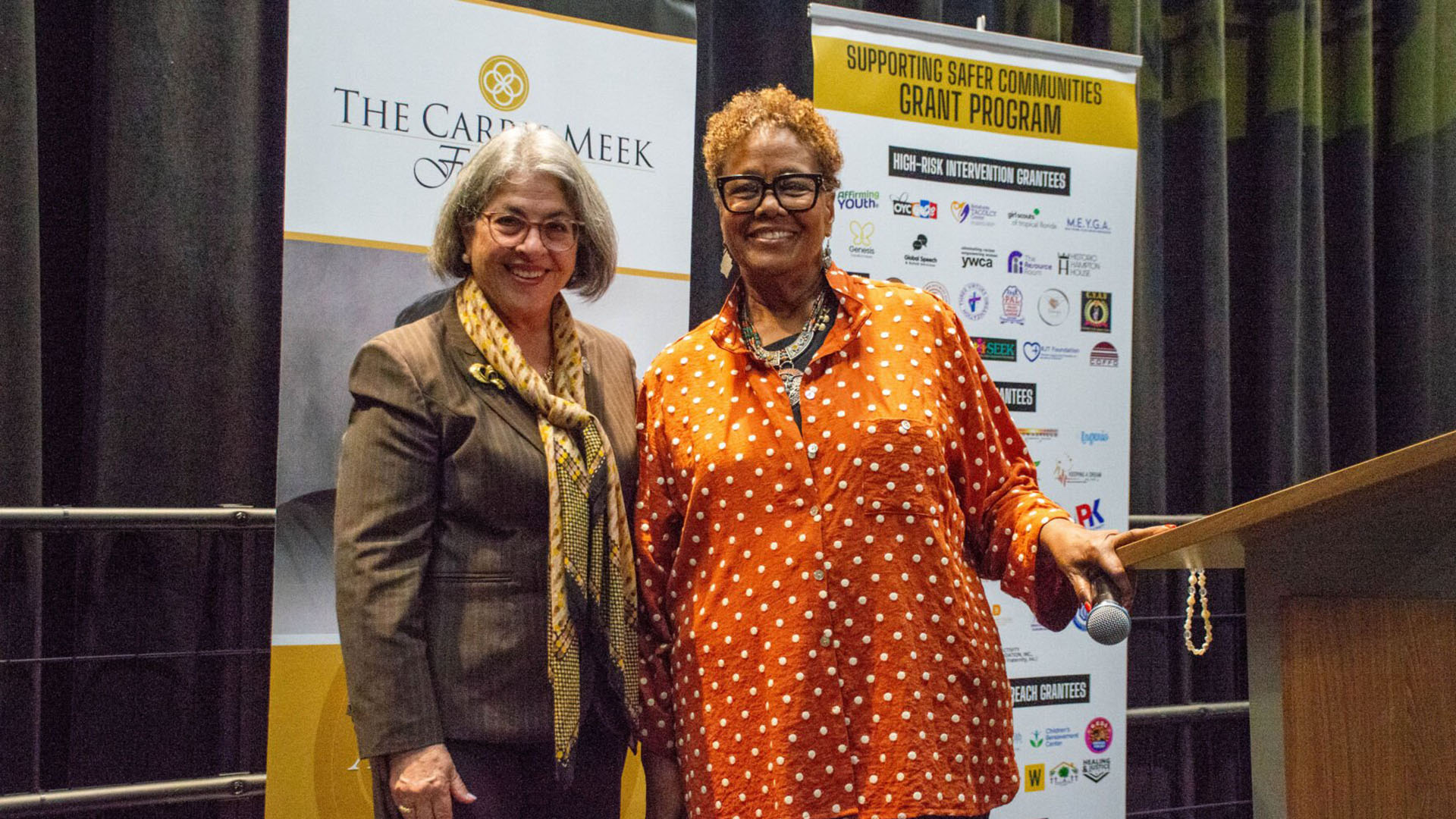
Miami-Dade Mayor Daniella Levine Cava and Carrie Meek Foundation Executive Director Lucia Davis-Raiford at the “Nonprofits in the Neighborhood” event.
Two years in, The Carrie Meek Foundation and county officials are touting deep community benefits from the Supporting Safer Communities initiative.
Amelia Orjuela Da Silva, Miami Times Staff Writer
Nov 19, 2025 Updated Nov 19, 2025
Read the Original Article Here
Last week, nonprofits from across Miami-Dade County packed the Marshall L. Davis, Sr. African Heritage Cultural Arts Center to mark the end of a two-year initiative: what happens when community-based groups are given public dollars — and room — to lead violence prevention on their own terms.
The event, “Nonprofits in the Neighborhood: The SSC Program’s Impact,” highlighted the Supporting Safer Communities Grant Program, a partnership between The Carrie Meek Foundation and Miami-Dade County. Since its launch in April 2023, the program has awarded more than $7.1 million to 82 organizations, reaching more than 20,000 residents.
“The most significant impact we’ve had was to enable organizations that work in neighborhoods locally to be part of the solution to their own neighborhood challenges,” said Lucia Davis-Raiford, executive director of The Carrie Meek Foundation.
Impact in the community
The SSC Program is a key part of Miami-Dade’s Community Violence Intervention Initiative, funded by an $8.8 million county investment championed by Mayor Daniella Levine Cava and unanimously approved by the Board of County Commissioners. Grants were distributed across four main areas: high-risk interventions, reentry services, mental health and victim support, and grassroots groups.
“You have made a real difference. You have made our community safer,” said Levine Cava. “You have worked the range from reentry programs to youth mentoring, mental health, and the arts. It’s a comprehensive look, a fabric, and that is what we need. It is a total fabric.”
An independent 2025 study by Scaling Safety found that ZIP codes with high concentrations of SSC-funded activity experienced sharp reductions in homicides. Homicides dropped 83% in ZIP code 33147, covering much of Liberty City, and 60% in ZIP code 33142, which spans Allapattah. In 33147, gun killings fell from 31 in 2020 to five in 2024, including a 72% drop between 2023 and 2024 alone.
Davis-Raiford emphasized that the work addresses far more than gun violence.
“You’re not gonna hear a lot of words from my mouth about gun violence. Because the fact of the matter is, our challenges are not so narrow as those,” she said. “Violence occurs in many, many ways, so we’ve managed to survive it.”
She credited nonprofits for leading efforts from within their own neighborhoods.
“You don’t need anybody parachuting in your community to tell you how to do it,” Davis-Raiford said. “What we need is the ability to reach out and manifest what our dreams are, and bring to life what our goals are, because we all want the same thing.”
From IDs to housing
Among the program’s largest collaborative efforts was the Umbrella of Hope Reentry Coalition, a network of more than 80 nonprofits that used a $315,000 SSC grant to support justice-involved residents across Miami-Dade. The coalition organized large-scale events offering employment referrals and legal, mental health, and rights restoration services.
“This particular grant was super important to us because it allowed us to provide direct services to justice-involved people throughout the county. That’s one of the communities that are underserved,” said Stephen Gilmore, executive director at Transition Inc. and administrator for the Project Umbrella One-Stop Reentry, a project within the coalition. “What made this particular program so unique is that it gave people an opportunity, because no one knows our community better than us. We are the experts for our community.”
A partnership with the Florida Department of Highway Safety and Motor Vehicles helped Project Umbrella alone issue 490 driver’s licenses. In total, they reported 474 employment referrals, 374 people receiving legal support, and 582 residents connecting with case managers or mental health services.
Gilmore said the numbers reflect real-life change.
“We’ve had participants who were incarcerated who are now employed. We’ve had people who are unhoused come to our reentry summit and get a place to live.”
CBOs as prevention tools
Other SSC grantees used the funding to bring prevention programs directly into schools, gardens, and neighborhood gathering spaces. Do Good 4-1, a nonprofit focused on STEM, used its $50,000 grant to teach robotics, coding, and engineering in high-need schools.
“The SSC grant was a blessing for us because we were able to go into communities that had no access to STEM,” said founder and President Max Joseph.
Joseph said the program served about 150 children. He described one fifth-grader who joined his school’s robotics club after participating.
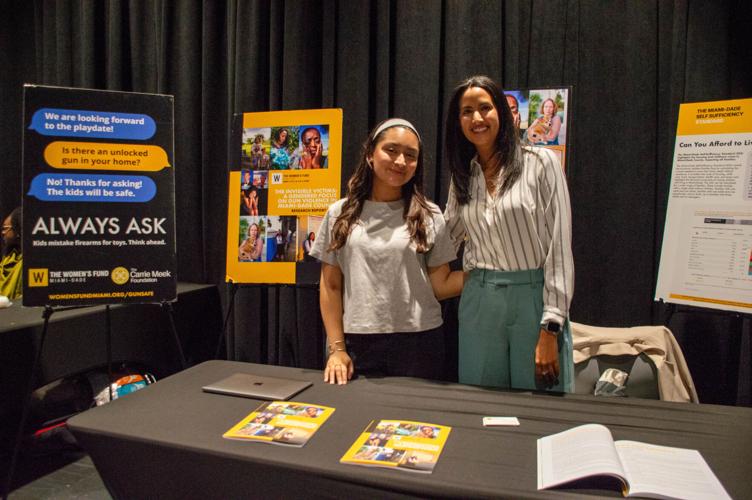
The Women’s Fund Miami-Dade used its $100,000 award to examine how gun violence impacts women and girls — a group often overlooked in public discussions.
(Amelia Orjuela Da Silva for The Miami Times)
“Now these kids can foresee going into a STEM college path or a STEM career.”
At Miami Youth Garden, SSC support funded after-school leadership programs providing gardening and nutrition education.
“We teach mentorship and leadership skills through gardening, healthy eating, to make sure that they have a healthy eating style and know what they can plant, and do garden-to-table food,” said Executive Director Dr. Yolanda Young.
In addition to teaching students gardening skills, healthy eating and wellness practices, the program also offers opportunities for interns and parents.
“It has given us access to more expensive things that we may not get in lower-income areas,” Young said.
In Brownsville, the Brownsville Civic Neighborhood Association (BCNA) and The Alternative Programs, Inc. used their grant to complete a mural honoring local Black leaders. Kenneth Kilpatrick, president of the BCNA and executive director at The Alternative Programs, Inc., said the project complemented his juvenile program, which brings court-involved youth to see the artwork.
“The grant financed the mural project, which was a huge success,” said Kilpatrick. “When we bring kids to that park now, we tell these children, ‘These are the icons that you can look up to,’ so it was a tremendous success.”
The invisible victims
Some SSC grants focused on research and policy gaps. The Women’s Fund Miami-Dade used its $100,000 award to examine how gun violence impacts women and girls — a group often overlooked in public discussions. The resulting report, The Invisible Victims, combined quantitative data from police departments with surveys, focus groups, and interviews.
“We also did a public awareness campaign that highlights them as kind of like these invisible victims that are not often part of the conversation,” said Viviana Alvarado Pacheco, Director of Research and Policy.
The data from five municipal police departments in 2022 highlights significant racial disparities in gun violence victimization among women. Among a total of 1,254 female victims, Black women faced a victimization rate more than nine times higher than white women. This disproportionate impact on Black women is consistent with national trends, as they accounted for 52% of victims compared to their white counterparts, who accounted for 19%.
“Funding is everything,” Alvarado Pacheco said. “We can’t really move or do a lot of the research that we want to do without the funding.”
What’s ahead
The SSC grant cycle ended June 30, attracting 246 applicants in total, but Davis-Raiford said the work is only beginning.
“What we’re trying to do is create positive collaboration of engaged citizens,” she said. “We will be looking for opportunities to continue this collaboration. It’s not going to look like this. It’s going to be more regionally based, but every opportunity that we have to create opportunities for organizations to work with us, with funding and instructors, and community-based, we’re gonna take it.”
Davis-Raiford said there is a new opportunity funded by the Department of Justice to engage men and boys as allies in preventing violence against women and girls, set to kick off in spring 2026.
“This is just step one,” she said.